GHc60.8bn loss: Policy choices by BoG during difficult times were for the greater good of the economy – Addison

GHc60.8bn loss: Policy choices by BoG during difficult times were for the greater good of the economy – Addison
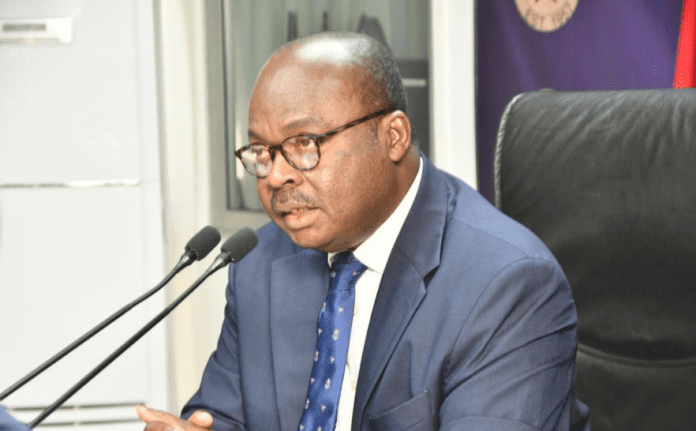
Governor of the Bank of Ghana (BoG), Dr Ernest Addion, has said that all that the Bank did as various shocks hit the economy was in line with prudent crisis management.
In 2020 pandemic, he said, the Central Bank supported the financing of the budget to protect lives and livelihoods.
Again, he added, in the 2022 economic and liquidity crisis, the Central Bank would not have acted differently but played its role as an automatic stabilizer to avoid pushing the economy to a tipping point which possibly could have spilled into social upheavals as was the case in Sri Lanka.
“It is very clear that only a Central Bank that has been prudently ran, built buffers, and well positioned, that can step in to support an economy from collapse. It is therefore most appropriate, I believe, to state that Ghanaians should rather applaud and commend the resilience of the Bank of Ghana,” Dr Addison said at the Chartered Institute of Bankers 2023 Governor’s Day in Accra.
Dr Addison further stated that the crisis ended with an International Moneyray Fund (IMF) bailout programme which was approved in May 2023. The corrective policies included stringent fiscal and monetary policies to help restore macroeconomic stability and debt sustainability while laying the foundation for inclusive growth.
It emerged from the discussions that ensued that macroeconomic adjustments alone would not be enough to deal with the problem of debt sustainability, as the debt sustainability analysis confirmed that Ghana’s debt would still not be sustainable even after
the expected macroeconomic adjustments and therefore some form of debt treatment was
needed to support the entire programme, he said.
“The structure of Ghana’s debt was such that both domestic and external debt treatments were required due to their almost equal proportions in the total debt. The Debt Exchange (DDE) program, where the stock of Government of Ghana debt was to be halved from 105 percent of GDP (including contingent liabilities) to 55 percent of GDP by 2028 was launched, starting off with the Domestic Debt Exchange.
“Implementation of the DDEP was not an easy task as it was the first time that a country in Africa had to undergo a debt restructuring programme, which not only covered external creditors, but also domestic creditors. Broadly, sovereign debt
workouts are painful, for the debtor country, its citizens, its creditors, and official creditors.
“It must be executed very carefully for the economy to return to normal economic activity
quickly. Under circumstances where access to credit markets remains unavailable, and trade finance is hampered, foreign direct investment is withered, and financial instability
remains, the longer it will take the economy to recover. The initial debt restructuring scenarios had to be tweaked several times between the initial
announcement and the final scenarios. On the domestic side, households, institutions,
pension funds and the Banks, somewhat saw less punitive treatment than initially designed.
“Given that the debt threshold remained unchanged, the Bank of Ghana had to therefore step in as the ‘loss absorber’ with a more punitive treatment (50% haircut) than initially
designed, leading to a large loss at the Bank of Ghana, driving it into negative equity at the
end of 2022.
“This is not to justify the losses, but to indicate that the policy choices made by the Bank during those difficult times were for the greater good of the economy. The Bank has commenced corrective actions to deal with the aftereffects of the losses and remains committed to the highest standards of sound management, transparent accounting, and good governance practises.”
Most central banks across the world experience losses in 2022.
In the case of Ghana, the main reason for the Bank of Ghana‘s GHS60.8 billion loss was the impairment of the holding of marketable Government stocks and non-marketable instruments of Government all being held in the books of the central bank, the Bank said earlier.
The BoG said this stock of government instruments has been built over the years. In addition, the Bank’s exposure to COCOBOD, which has been built over the years, was also impaired.
“As we all know, the Government of Ghana embarked on both domestic and external debt restructuring. The holdings of Government instruments and COCOBOD exposures were all part of the perimeter of the debt exchange. Whereas all other stakeholders that participated in the Domestic Debt Exchange (DDEP) did not have principal haircuts, but rather had new instruments with new tenors and coupon structure, the BoG, which served as the loss absorber to the entire debt exchange program, a key requirement that allowed the Government of Ghana to meet the threshold for the approval of the IMF programme
“As a result, the BoG had to take on a 50 percent principal haircut on the total principal (which stood at GHC 64.5 billion at the time of the exchange),” the BoG said in statement providing answers to frequently asked questions on the losses on Tuesday, August 1, 2023.
It added “Consequently, BoG had new instruments with extended tenor and significantly reduced coupon. By applying the full requirements of IFRS 9, this means that from the principal alone, a 50 percent haircut on the non-marketables amounted to a loss of GHC32.3 billion.
“The impairment from exposure to COCOBOD also amounted to GHC 4.7 billion. These three DDEP items (ie marketable, non-marketable and COCOBOD) accounted for GHC53.1 billion out of the total loss of GHC 60.8 billion for 2022. In addition to these three items, price and exchange rate valuation effects accounted for GHC 5.2 billion of the total loss, whereas interest expense on cost of monetary policy operation accounted for GH3.3 billion.”
Due to the impairment of the Government of Ghana’s securities holdings of ¢48.45 billion, impairment of loans and advances granted to quasi-government and financial institutions amounting to ¢6.12 billion and the depreciation of the local currency resulting in net exchange loss of ¢5.27 billion, the Bank of Ghana recorded GHS60.6billion loss in 2022.
In a statement answering some questions relating to this matter the BoG said “Are there Central Banks that made losses in 2022 comparable to what Ghana experienced in 2022? The Bog said in 2022, several central banks run losses and, in some cases, the losses pushed them into negative equity. Let me touch on a few of them and the statistics:
“The Reserve Bank of Australia (RBA) recorded a 2022 book loss of 37 billion Australian dollars, which more than wiped out the central bank’s equity. The UK Government faces £150 billion bill to cover Bank of England’s losses (According to the Financial Times of July 25, 2023).
“The Swiss National Bank (SNB) in early January reported a record preliminary loss of 132
billion francs for 2022. In September 2022, the central bank of the Netherlands notified the country’s government in a letter that it projects net interest losses amounting to a potential EUR 9 billion for the years 2023 through 2026. The US Federal Reserve has no longer been able to remit weekly billion-dollar transfers to the US Treasury since autumn 2022. Instead, a debt obligation to the US Treasury (a liability that the Fed recognizes as a deferred asset) has been growing on the Fed’s balance sheet since then. The Fed eventually will have to pay this liability sometime in the future (when it resumes generating profits).
“For the financial year ended 31 March 2023, the Monetary Authority of Singapore recorded
a net loss of $30.8 billion. Why Central Banks are reporting losses in 2022: Central banks exist to fulfil their policy mandates, including price and financial stability.
“The attainment of this mandate involves the central bank taking on financial risks such as credit risk and interest rate risks, through loans to commercial banks/government or currency risk, through the holding of foreign exchange reserves.
“Some of these risks may materialize leading to losses. Making losses may therefore be perfectly compatible with a central bank’s remit of ensuring the smooth functioning of the economy.
“It contributes to a well-functioning economy by maintaining confidence in the financial system and by stabilizing inflation and economic activity. Therefore, the success of central bank interventions should always be judged on whether they fulfil these mandates.
About The Author