The creation of a local gold refinery is part of govt’s efforts to ensure Ghana rakes in maximum benefits from its natural resources – Jinapor
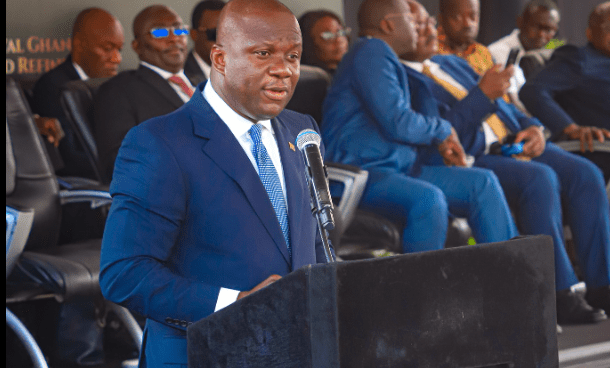
The creation of a local gold refinery is part of govt’s efforts to ensure Ghana rakes in maximum benefits from its natural resources – Jinapor

The Minister for Lands and Natural Resources, Samuel A. Jinapor, has disclosed that government, right from the onset, recognized that for Ghana to enjoy maximum benefit from its natural resources, there must be a paradigm shift from the archetypal method of exploiting resources to a modernized and value-addition-based harnessing of the resources.
Mr Jinapor said that Vice President Dr. Mahamudu Bawumia has been at the forefront of the initiative, with his commitment, expertise, and knowledge proving crucial in the implementation of various policies aimed at enhancing the exploitation of resources in the country.
“The Vice President has been at the forefront of policies aimed at ensuring optimal benefits from our mineral resources and improving the livelihoods of our people, including the digitalization of the National Assay Laboratory, the Domestic Gold Purchase Programme, which has led to a tremendous increment in our gold reserves, and the Gold for Oil Programme, which has contributed over thirty percent (30%) of our total crude consumption.
“The reconstruction of the Appiatse community, which was razed down some two years ago, and the ongoing efforts at digitalizing the records of the Lands Commission to make it fit for purpose are also some of the remarkable interventions of the Vice President in the Lands and Natural Resources sector,” he said.
The Minister stated that the establishment of the Royal Gold Refinery is a feather in the cap of the government pursuant to its bid to ensure that Ghana rakes in the maximum benefits from its resources and also becomes the hub of mineral refinery in the sub-region.
“And this afternoon, Ladies and Gentlemen, he (Dr. Bawumia) unveils a great milestone that embodies our commitment to value addition, thereby realizing the vision of the Akufo-Addo/Bawumia Government to make Ghana the mining hub of Africa, where all mining and mining-related activities, from exploration to downstream production, and from research to innovation, will be centered.”
He disclosed that the efforts to build refineries continue unabated with the construction of a $450 million manganese refinery at Nsuta in the Western Region, which will be the bedrock of the growth of the steel, aluminum, and copper industries in Ghana.
He further stated that the arrival of the refinery presents a huge boost in Ghana’s quest to secure a London Bullion Market Association (LBMA) Certification to ensure that the country can trade its refined gold on the international market.
The Vice President Dr Mahamudu Bawumia for his part said the Cedi can be best supported with gold.
To that end, he has proposed a framework that will ensure that all significant demand for gold are channeled through the Bank of Ghana’s gold purchase programme.
Speaking at the inauguration of the Royal Ghana Gold Refinery Dr Bawumia “I would like to propose a new foreign exchange regime management architecture for Ghana next year in which the value of the cedi with everything we have put in will be anchored to gold. I want us to move our foreign exchange management because we need an anchor and I believe that the best anchor for the Cedi is gold. I want us to anchor the Cedi to gold.
“I am proposing a framework which we will discuss with the central bank, of course, and we will see where. But the framework that I am proposing is very simple. Having looked at all that we have done, all significant demand for gold should be channelled through the Bank of Ghana’s gold purchase programme. If you have GHȼ3 billion and you are looking to buy forex, the Bank of Ghana can take the GHȼ3 billion and buy gold and give you your forex. Demand equals supply, exchange rate doesn’t move.
“It is just a simple use of our gold reserves to meet the demands of forex. Once you can anchor the Cedi with gold so that you are able to meet demand then there are so many extra forex reserves to do other things for the country. But then you will maintain long-term exchange rate stability, which will be anchored on gold and then we will move forward.”
For his part, Governor Dr Ernest Addison said the establishment of Royal Gold Ghana Limited (RGGL) a local gold refinery in Ghana, will no doubt provide impetus to the Bank of Ghana’s (BoG’) successful Domestic Gold Purchase Programme (DGPP).
Under the DGPP, he said, the Bank of Ghana has been able to accumulate sizable foreign exchange buffers, for the most part, significantly exceeding expectations under the IMF programme.
Since inception of the Domestic gold purchase programme, he said, the Bank of Ghana has bought 65.4 tons of gold, valued at US$5.07 billion.
“This year, since January, the Bank has bought 23 tons of gold valued at about US$1.8 billion. The programme, along with other donor disbursements, puts the Bank in a favourable position to support the country’s external payments obligations as and when they fall due,” Dr Addison said also during the opening of Royal Gold Ghana Limited (RGGL) on Thursday, August 8.
Dr Ernest Addison further said that gold is currently the leading export commodity with projected export earnings for 2024 estimated at close to US$10 billion.
Its value chain presents immense opportunities for job creation, increased foreign exchange earnings, and economic development, he said.
Even though Ghana has exported minerals, in particular Gold for over a century, its full potential on the local economy has yet to be fully realized, he observed.
The exportation of raw materials without value addition results in potential loss of revenue and jobs, he said.
Dr Addison said the opening of this gold refinery opens a new era to promote gold beneficiation and value addition which will contribute to economic growth, poverty reduction, and ultimately improvement in the livelihoods of Ghanaians.
These are all based on the notion that value addition to Ghana’s gold resources holds the potential to increase foreign exchange earnings, improve the balance of payments position, and in turn, provide enough buffers against external vulnerabilities and shocks to the economy, he said.
“This refinery will also play an important role in reducing gold smuggling, which has been a major challenge for the country over the years. By providing a ready market for artisanal and small-scale miners, the gold refinery can mitigate the incentive for smuggling and help promote transparency and accountability in gold trading,” Dr Addison said.
In the long run, he added, when RGGL receives London Bullion Market Association (LBMA) Good Delivery List accreditation, Ghana will gain additional benefits such as reduced dependence on foreign refineries.
Also, he said, the central bank can diversify and organically grow its foreign exchange reserves, as well as accumulate more refined gold reserves to reduce dependence of external borrowing. Last but not the least, the presence of a local gold refinery will enable the production of gold coins and other artifacts which can act as a safe-haven asset, and will broaden investment options in the financial markets and contribute to financial stability.
“Today’s event will no doubt provide impetus to BoG’s successful Domestic Gold Purchase Programme (DGPP). Under the DGPP, the Bank of Ghana has been able to accumulate sizable foreign exchange buffers, for the most part, significantly exceeding expectations under the IMF programme. Since inception of the Domestic gold purchase programme, the Bank of Ghana has bought 65.4 tons of gold, valued at US$5.07 billion. This year, since January, the Bank has bought 23 tons of gold valued at about US$1.8 billion. The programme, along with other donor disbursements, puts the Bank in a favourable position to support the country’s external payments obligations as and when they fall due.
“The benefits of establishing a local gold refinery broadly aligns with Bank of Ghana’s objective to build adequate foreign reserves to stabilise the economy during adverse domestic and external shocks and help achieve its core mandate of price stability, and we are extremely pleased with the opening of the Refinery today. Finally, let me congratulate the Board, Management, and staff of RGGL on this achievement. Your hard work and dedication have paid off, and we look forward to impactful operations of this new refinery on the Ghanaian economy. To the key stakeholders, including the Government of the Republic of Ghana, mining companies, and artisanal and small-scale miners, I urge you all to support this bold initiative. Let us work together to promote the growth of our gold industry, add value to our natural resources, and build a prosperous future for our nation. Congratulations to RGGL once again and I wish you success in your operations. Thank you and May God bless our homeland Ghana.”
About The Author